
Learn what Pu-erh tea is, how it's made, the differences between Sheng and Shu Pu-erh, and why it's one of the world's most unique fermented teas.
Previous post
What Is Pu-erh Tea? History, Types, Benefits & Brewing Guide | Blue Faro
Date
When we think about tea, we often picture a tea bag steeping in a cup of hot water. But the world of tea is much bigger than that.
Behind a cup of specialty tea there is a plant, an origin, a variety, a growing environment and, above all, a process that can completely transform the final cup.
From delicate white teas to intense black teas, as well as green, oolong, yellow and dark teas, the main families of tea all come from the same species: Camellia sinensis.
In this guide, we’ll explain what tea really is, introduce the six main tea families, and explore the difference between loose leaf tea and industrial tea bags.
Before looking at different types of tea, there is one fundamental thing to understand: all true tea comes from the same plant, Camellia sinensis.
Camellia sinensis is an evergreen plant from the Theaceae family. Its young leaves and buds are harvested and then processed in different ways.
This means that green tea, white tea, oolong tea and black tea do not come from different plants. The main difference is what happens to the leaves after they are picked.
International tea classification recognizes six main tea types:
The main differences between them come from how the leaves are processed, particularly how oxidation is controlled.
There is an important distinction here.
Chamomile, mint and rooibos are not made from Camellia sinensis. They are herbal infusions rather than true tea.
So when we talk about tea in the strict sense, we are talking about products made from Camellia sinensis.
The fact that all true teas come from the same species does not mean that they all taste the same.
Different varieties and cultivars are adapted to different climates, altitudes and growing regions. Two teas from different regions can therefore have completely different sensory profiles.
The environment matters too. Altitude, soil, climate, rainfall, sunlight and harvesting season can all influence the development of the plant and the characteristics of the leaves.
But one of the most important factors is processing.
After harvesting, tea producers can control processes such as withering, rolling, oxidation, heat fixation, drying and, for some teas, further fermentation or ageing.
Understanding tea is therefore not only about learning the names of famous origins. It is also about understanding what happens to the leaf between the plantation and your cup.
White tea is one of the least processed tea styles.
It is generally made from young buds and leaves that are withered and dried with relatively little intervention.
White teas can be delicate, floral, sweet and fresh, although there is considerable diversity within the category.
Well-known examples include Silver Needle, or Baihao Yinzhen, and White Peony, or Bai Mudan.
In the cup: delicate, floral, sweet and fresh.
With green tea, the goal is to prevent significant oxidation after harvesting.
The leaves are therefore heat-treated to deactivate the enzymes responsible for oxidation. Depending on the origin and production method, this can involve dry heat, steaming or other techniques.
The result is an enormous range of flavours.
A Japanese green tea may show vegetal, marine or umami characteristics, while some Chinese green teas can be more roasted, floral, sweet or herbal.
In the cup: vegetal, fresh, floral, roasted or umami, depending on origin and processing.
Yellow tea is probably one of the least familiar tea categories outside major tea-producing and tea-consuming markets.
Its production shares some steps with green tea but includes an additional process known as yellowing.
This changes the character of the leaves and generally creates a softer and rounder profile than many green teas.
It is a relatively small category with a long tradition in China.
In the cup: soft, sweet, rounded and gently vegetal.
Oolong tea, sometimes called blue tea, occupies a broad space between green and black tea in terms of processing.
The leaves are withered, manipulated and partially oxidized before being fixed and dried. The degree of oxidation can vary considerably.
That is why oolong is such a diverse category: some examples are light, floral and fresh, while others are roasted, creamy and deep.
In the cup: floral, fruity, creamy, roasted or mineral, depending on style.
With black tea, the leaves undergo much more extensive oxidation before drying.
This process dramatically changes the colour, aroma and flavour of the leaves.
Assam, Darjeeling and Ceylon teas, as well as many Chinese black teas, belong to this broad family.
Depending on origin and processing, black tea can show notes of ripe fruit, spices, honey, cocoa, wood or malt.
In the cup: intense, malty, spicy, fruity or sweet.
Red tea includes teas that undergo additional microbial fermentation and/or ageing after their initial processing.
The best-known example is Pu-erh, traditionally associated with Yunnan, China.
This category includes very different styles, from relatively fresh young teas to mature teas with deep, earthy and fermented characteristics.
In the cup: earthy, woody, deep, spicy or fermented.
These six categories are defined in the international ISO 20715:2023 tea classification standard.
One of the most noticeable differences when discovering specialty tea is the physical form of the leaf.
Open a conventional supermarket tea bag and, in many cases, you will find very small tea particles known as fannings or dust.
These terms describe particle size. They do not necessarily mean that the contents are artificial or that they are not tea: they are still parts of the Camellia sinensis leaf, but they are much more fragmented.
There is a practical reason.
Smaller particles have a much greater surface area relative to their volume. This allows water to extract soluble compounds quickly and creates a strong infusion in just a few minutes.
That makes them particularly suitable for a format designed around convenience and speed.
The difference becomes more noticeable when we want to explore the aromatic complexity of a quality tea.
Whole or lightly broken leaves retain a different physical structure and can gradually unfurl during brewing. This can allow for a slower extraction and a more layered sensory experience.
No.
There are good-quality teas available in tea bags, just as there are mediocre loose leaf teas. The format alone does not determine quality.
However, loose leaf tea gives you a different way to experience the product. You can see the leaves, control the amount more easily and observe how they open and evolve during brewing.
The difference between industrial tea and specialty tea is therefore not simply about whether the tea comes in a bag.
Other factors matter too:
Specialty tea does not simply mean “expensive tea” or “loose leaf tea”.
The term is generally used for teas where greater attention is paid to factors such as provenance, raw material quality, processing and sensory characteristics.
Instead of treating tea as a generic commodity, specialty tea allows us to understand more of its journey:
origin → cultivation → harvesting → processing → grading → storage → brewing → cup.
It also changes the way we taste tea.
Rather than looking only for a hot drink with a familiar tea flavour, we can begin to identify aroma, sweetness, bitterness, astringency, texture and how the flavour evolves throughout the infusion.
You do not need specialist equipment to start.
A simple way to begin is to choose different tea families and pay attention to how they taste.
If you enjoy fresh and vegetal flavours: try a green tea.
If you prefer something delicate and floral: start with a white tea.
If you are looking for floral aromas and greater complexity: explore an oolong.
If you prefer an intense and structured cup: try a black tea.
If you enjoy deep and earthy flavours: discover Pu-erh or another dark tea.
And most importantly, try teas from different origins. The same tea category can taste completely different depending on where it is grown and how it is processed.
At Blue Faro, we select teas from different producing regions to help you discover the world of loose leaf tea and explore the character of each origin.
Our collection includes teas from China, Japan, India and Vietnam, with styles ranging from white, green, oolong and black teas to Pu-erh and herbal infusions.
You don't need to know exactly what you like before you start. Choose a tea family, explore different origins and let your palate guide you.
Discover our tea collection and find your next cup.
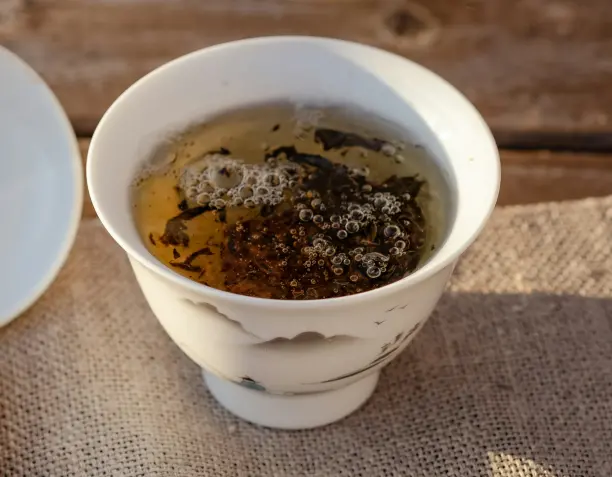
Learn what Pu-erh tea is, how it's made, the differences between Sheng and Shu Pu-erh, and why it's one of the world's most unique fermented teas.