
Is your espresso running too fast or choking? Stop wasting beans and learn how to dial in your professional grinder with Blue Faro.
Next post
Dialing In: How to Calibrate a Professional Espresso Grinder
Date
Grinding coffee is a necessary process. High-speed burrs (around 1200 RPM) transform roasted beans into powder, releasing volatile oils and aromas. However, not all grinders are created equal.
Commonly sold as "coffee grinders," these devices are essentially blenders. They hack beans into irregular shards instead of grinding them.
The Issue: Uneven particle size leads to uneven extraction. You get a confusing mix of bitterness (from over-extracted dust) and sourness (from under-extracted chunks).
Pro Tip: If a burr grinder isn't in your budget yet, buying pre-ground specialty coffee is often a "lesser evil" than using a blade grinder.
Burr grinders use two revolving abrasive surfaces to crush beans into a specific size. This uniformity is what allows for a balanced, professional-grade cup.
Stepped vs. Stepless: Stepped grinders have pre-defined settings (clicks), while stepless grinders allow for infinite adjustments—crucial for "dialing in" the perfect espresso.
Ceramic vs. Steel: Ceramic burrs stay sharp longer and produce less heat, whereas steel burrs dissipate heat faster and are often preferred for their clarity in filter coffee.
Conical Burrs: They use gravity to pull beans through, running at lower RPMs (300-500). They are quiet, efficient, and offer great control over the grind profile.
Flat Burrs: These use centrifugal force to push beans through two horizontal rings. They are prized in the specialty industry for producing a highly unimodal (uniform) grind distribution.
In the world of specialty coffee, consistency is everything. When particles are the same size, they release flavor at the same rate.
Over-extraction: Happens when particles are too fine, leading to a bitter, dry taste.
Under-extraction: Happens when particles are too coarse, resulting in a sour, weak cup.
The general rule is: The shorter the brew time, the finer the grind.
Extra Fine: Turkish Coffee.
Fine: Espresso and Moka Pot.
Medium: Pour-over (V60, Chemex) and AeroPress.
Coarse: French Press and Cold Brew.
Investing in a quality grinder—whether a manual one for $50-$100 or a pro-sumer electric model—is the single most important upgrade you can make to your coffee routine. As the saying goes: The grinder is more important than the coffee machine.
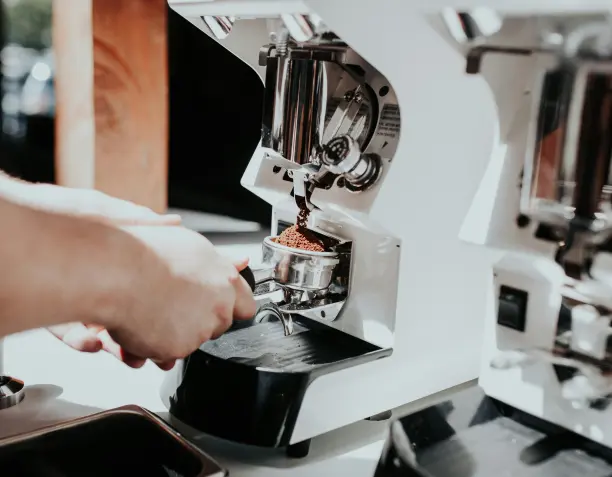
Is your espresso running too fast or choking? Stop wasting beans and learn how to dial in your professional grinder with Blue Faro.