
Do you know if your coffee is properly roasted? Discover the difference between roast color and bean development to avoid grassy flavors.
Next post
Understanding Coffee Roasting: Color, Development and Roast Speed
Date
Green coffee bears little resemblance to the coffee we drink every day. Its beans are dense, green, and have a grassy aroma, making them unsuitable for brewing.
Only through coffee roasting do green beans develop the complex aromas, sweetness, body, and flavor that define specialty coffee.
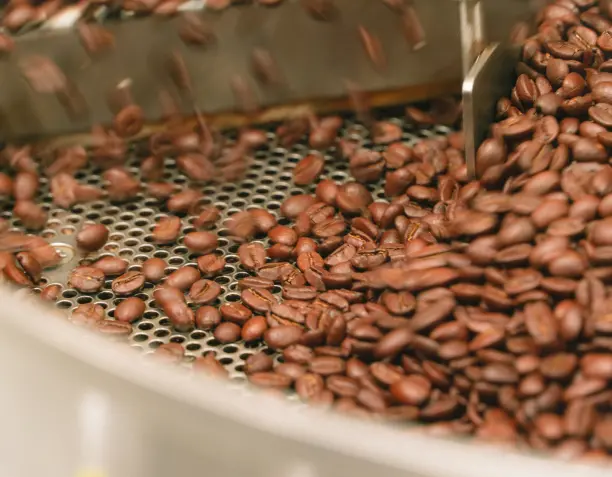
Roasting is far more than simply heating coffee. It is a precise balance of time, temperature, airflow, and heat transfer, carefully controlled to reveal the full potential of each origin.
Coffee roasting involves heating green coffee beans under carefully controlled conditions, typically between 160°C and 220°C (320–428°F).
Depending on the roasting style, the process usually lasts between 8 and 20 minutes.
As roasting progresses, moisture evaporates, the beans expand, sugars caramelize, and hundreds of new aromatic compounds are formed.
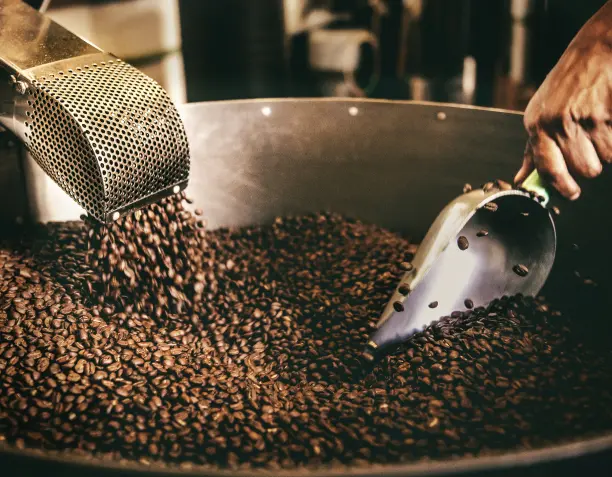
Once the desired roast profile has been achieved, the beans are rapidly cooled to stop the chemical reactions.
Before roasting, green coffee is cleaned to remove stones, dust, and other foreign materials that could damage roasting equipment or reduce coffee quality.
As heat penetrates the bean, its color gradually changes from green to yellow, then cinnamon, and finally to different shades of brown.
During roasting, beans expand by approximately 30–40%, while losing weight as water and volatile compounds evaporate.
Large amounts of carbon dioxide are also generated inside the bean, playing an important role in espresso extraction and coffee freshness.
Once the desired roast level has been reached, the coffee must be cooled immediately.
Rapid cooling prevents residual heat from continuing the roasting process and altering the intended flavor profile.
Depending on the final product, coffee may be sold as whole beans or ground coffee.
Freshly roasted coffee is typically packaged in bags equipped with one-way degassing valves, allowing carbon dioxide to escape while preventing oxygen from entering.
Roasting triggers hundreds of simultaneous chemical reactions.
Natural sugars begin to caramelize and react with amino acids through the Maillard reaction, creating the brown color and many of coffee's characteristic aromas.
These reactions also produce melanoidins, compounds that contribute sweetness, body, and complexity to the final cup.
Meanwhile, proteins, polysaccharides, and organic acids break down into hundreds of new flavor molecules.
Hemicellulose produces compounds such as furfural and furfuryl alcohol, which contribute caramel-like and nutty aromas.
Trigonelline partially decomposes into pyridines, key contributors to roasted coffee aroma, while also forming small amounts of nicotinic acid (vitamin B3).
Although a small amount of caffeine is lost during roasting, its relative concentration remains largely unchanged because the beans lose moisture.
Coffee is one of the most chemically complex foods in the world.
During roasting, more than 800 volatile aromatic compounds are formed.
These include pyrazines, furans, phenols, aldehydes, ketones, sulfur compounds, and many other molecules that together create notes of chocolate, caramel, nuts, spices, flowers, and fruit.
Every coffee origin, variety, and roast profile produces a unique balance of these compounds, giving each coffee its own sensory identity.
Roasted coffee contains significant amounts of carbon dioxide trapped inside each bean.
After roasting, this gas is slowly released through a process known as degassing.
Grinding dramatically accelerates degassing, carrying many volatile aromatic compounds away with the escaping carbon dioxide.
This explains why freshly ground coffee always smells far more intense than pre-ground coffee.
For the same reason, specialty coffee is packaged with one-way valves and is best enjoyed within a few weeks of roasting.
Over time, oxygen gradually breaks down the aromatic compounds responsible for coffee's flavor.
Although modern packaging significantly slows oxidation, it cannot stop it entirely.
That is why specialty coffee roasters produce smaller, fresher batches, ensuring every bag delivers the maximum aroma, sweetness, and complexity the coffee has to offer.
At Blue Faro, we believe exceptional coffee begins at origin—but reaches its full potential through carefully crafted roasting tailored to every individual lot.
Do you know if your coffee is properly roasted? Discover the difference between roast color and bean development to avoid grassy flavors.
Looking for a bright, fruity cup? Learn how to control coffee acidity during the roast using RoR, temperature, and the first crack.
Learn how to describe coffee roasting profiles: light, medium and dark roasts, roast development, baked coffee, stalled roasts, and flavor impact.