
Previous post
Why Coffee Pre-Infusion Matters for Espresso and Pour Over Brewing

Date
Coffee extraction is the process through which water dissolves and carries soluble compounds from ground coffee into the final beverage.
As water comes into contact with coffee particles, it progressively extracts compounds that contribute to flavor, aroma, body, sweetness, acidity, and texture.
Controlling extraction is essential for brewing balanced coffee. Under-extraction can produce sharp acidity, sourness, vegetal flavors, and a lack of sweetness, while over-extraction can result in bitterness, dryness, and astringency.
Two of the most important variables controlling this process are contact time and surface area, which is strongly influenced by grind size.
The longer water remains in contact with coffee, the more soluble compounds it can dissolve.
However, coffee compounds do not all dissolve at the same rate. Different soluble components have different levels of solubility and therefore become available to the water at different stages of the brewing process.
In general, early stages of extraction contribute strongly to bright acidity and some of the lighter flavor compounds. As extraction continues, more compounds associated with sweetness, body, and roasted aromas become available.
If extraction continues too far, compounds associated with bitterness, dryness, harshness, wood, or ash-like flavors can become increasingly noticeable.
This is why more extraction does not automatically mean better coffee. The goal is to find a balanced point where the right combination of compounds reaches the cup.
The second major variable is the surface area of the coffee exposed to water.
Grinding coffee breaks the beans into smaller particles and dramatically increases the total surface available for extraction.
The finer the grind, the greater the total surface area exposed to water.
Imagine a 1 cm coffee cube. Its six sides give it a total surface area of 6 cm².
If it is divided into eight cubes measuring 0.5 cm per side, the total surface area increases to 12 cm².
Dividing those particles again into smaller pieces increases the total surface area to approximately 24 cm².
This simple geometric principle explains why grind size has such a strong influence on extraction speed.
A finer grind exposes more coffee surface to the water.
This allows water to access and dissolve soluble compounds more quickly. As a result, a finer grind generally increases extraction, while a coarser grind tends to slow it down.
Grind size does not change which compounds exist inside the coffee bean. Instead, it changes how easily and how quickly water can access those compounds.
The coffee already contains the compounds that can potentially reach the cup. Grinding simply determines how much of that material becomes accessible during the available brewing time.
Large coffee particles create a longer path for water to travel before reaching their interior.
Water must penetrate the coffee structure, dissolve soluble compounds, and transport them back toward the surface.
With smaller particles, this path is much shorter.
This is why coarser grinds generally require longer contact times to reach a similar level of extraction compared with finer grinds.
This relationship is particularly important when comparing different brewing methods.
If a coffee is under-extracted, some of the variables that can be adjusted include:
If a coffee is over-extracted, possible adjustments include:
Whenever possible, adjust one variable at a time. This makes it easier to understand which change actually improved the cup.
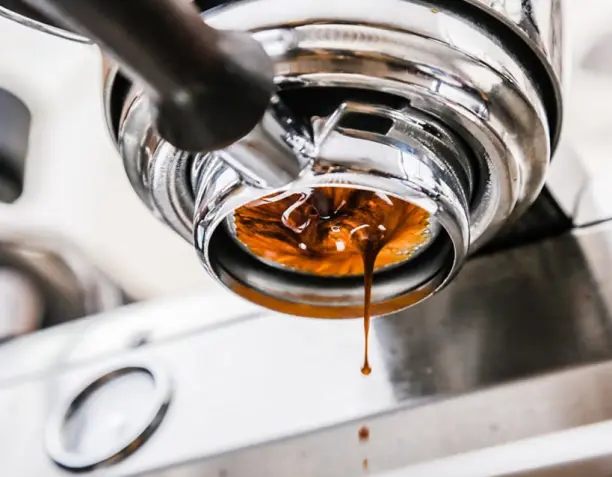
Espresso presents a particular challenge because the brewing time is relatively short.
Water passes through the coffee bed within seconds and does so under pressure. This makes grind uniformityparticularly important.
If the coffee contains too many large particles, some areas may remain under-extracted while smaller particles receive excessive extraction.
For this reason, a grinder capable of producing a consistent particle distribution is essential for achieving more even extraction.
In espresso, small changes in grind size can significantly affect extraction time and the balance between acidity, sweetness, bitterness, and body.
Filter coffee generally uses longer contact times than espresso and usually relies on a coarser grind.
The appropriate grind size depends on the specific brewing method and the amount of time available for extraction.
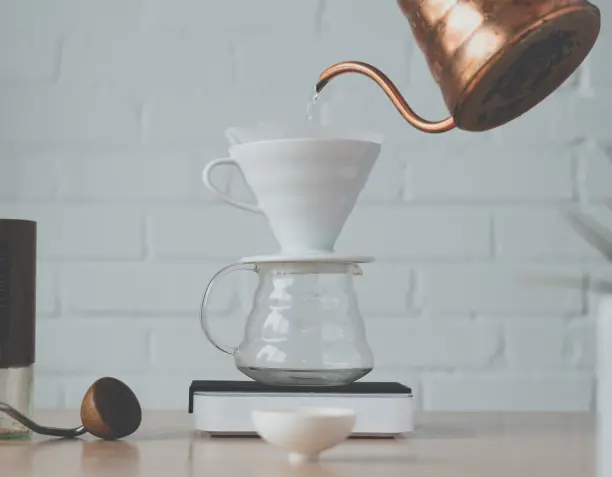
In pour-over brewing, for example, water passes through the coffee bed by gravity. Grind size, water volume, pouring technique, agitation, and the resistance of the coffee bed all influence contact time.
Immersion methods such as the French press work differently: the coffee remains submerged in water for a defined period before the grounds are separated from the brewed coffee.
In both cases, the goal is to find the right relationship between grind size and contact time.
Ground coffee is never made up of particles that are exactly the same size. Even a high-quality grinder produces a distribution of particle sizes.
This means that during brewing, smaller particles can extract quickly while larger particles require more time.
This creates one of the fundamental challenges of coffee extraction:
while waiting for larger particles to extract sufficiently, smaller particles continue extracting.
If the brewing time is too short, larger particles may remain under-extracted.
If the brewing time is too long, smaller particles may become over-extracted.
This is why a more uniform grind distribution can help produce a more even extraction and make brewing easier to control.
The flavor in the cup provides important clues.
It may taste:
It may taste:
However, extraction is not the only factor responsible for these sensations. Coffee origin, processing method, roast profile, water chemistry, brewing method, and many other variables also influence the final cup.
Coffee brewing is not simply about extracting as much as possible.
The goal is to extract the right compounds in the right proportions.
Time, grind size, water temperature, water chemistry, agitation, and brewing method all interact to determine the final result.
A well-extracted coffee allows sweetness, acidity, body, and aroma to work together in balance.
So when a cup does not taste as expected, the solution is not always to simply increase or decrease brewing time. Understanding the relationship between time, grind size, and surface area allows coffee to be adjusted with much greater precision.

Learn how to make the perfect espresso with this professional step-by-step guide. Discover the ideal grind size, extraction time, tamping technique and barista tips for better coffee.
Learn how coffee pre-infusion improves extraction, prevents channeling, and enhances espresso and pour-over brewing while understanding when to skip it.