
Learn about the main green coffee defects, their causes and how they can affect roasting, extraction and the flavor of the final cup.
Previous post
Coffee Processing Explained: Natural, Washed & Honey
Date
Among the many fascinating terms in specialty coffee, Peaberry is one of the most misunderstood. It is often marketed as a premium or rare coffee, but what exactly makes it different?
In this guide, we'll explain what a Peaberry coffee bean is, how it forms, whether it affects flavor, and why it often commands a higher price.
A Peaberry is a natural mutation that occurs during the development of a coffee cherry.
Normally, each coffee cherry contains two seeds growing side by side. Because they press against each other, each bean develops one flat side and one rounded side.
In a Peaberry, however, only one seed develops.
Instead of sharing the available space, the single bean grows into a round, pea-shaped seed, which is where the name "Peaberry" comes from.
In some producing countries it is also known as Caracol or Pearl Coffee.
Researchers still don't know exactly why this happens.
One common misconception is that a Peaberry consists of two beans fused together.
In reality, one of the seeds simply fails to develop, allowing the other to occupy the entire cherry.
It is a completely natural occurrence that can appear in almost any coffee variety.
Peaberries are relatively uncommon.
They typically account for around 5–10% of a coffee harvest, although the percentage varies depending on origin, variety, and growing conditions.
Many producers separate these beans during sorting and sell them as a dedicated Peaberry lot.
This remains one of the biggest debates in specialty coffee.
Some coffee professionals believe that because only one bean develops, it receives more nutrients from the coffee cherry.
According to this view, Peaberries may produce sweeter, more complex, and more concentrated cups.
Others argue that there is no scientific evidence proving that Peaberries consistently taste better than regular coffee beans.
Most sensory differences are still driven by factors such as:
A high-quality traditional lot can easily outperform an average Peaberry coffee.
Peaberry coffees often cost more because they are relatively rare.
They also require an additional sorting process, either by screen size or manual selection, which increases production costs.
Combined with growing consumer interest, this makes Peaberry lots more exclusive than standard coffees.
Peaberries can occur in virtually any coffee-producing country.
However, some origins are especially well known for marketing Peaberry coffees, including:
Ultimately, any coffee farm can naturally produce Peaberries.
Absolutely.
While there is no consensus that Peaberry always tastes better, it offers an interesting opportunity to explore one of coffee's many natural variations.
The best way to judge it is to compare a high-quality Peaberry with a traditional lot from the same origin and variety.
Peaberry is neither a defect nor a miracle bean.
It is simply a natural mutation in which only one seed develops inside the coffee cherry.
Its rarity and additional sorting process make it more exclusive, but its quality—like any specialty coffee—ultimately depends on the producer, origin, processing, and roasting.
At Blue Faro, we believe every coffee should be judged by what it delivers in the cup. Whether it's a Peaberry or a traditional lot, thoughtful sourcing and careful roasting are what truly unlock exceptional flavor.
Learn about the main green coffee defects, their causes and how they can affect roasting, extraction and the flavor of the final cup.

How does coffee processing change your cup's flavor? Discover the differences between natural, washed, and honey methods with Blue Faro.
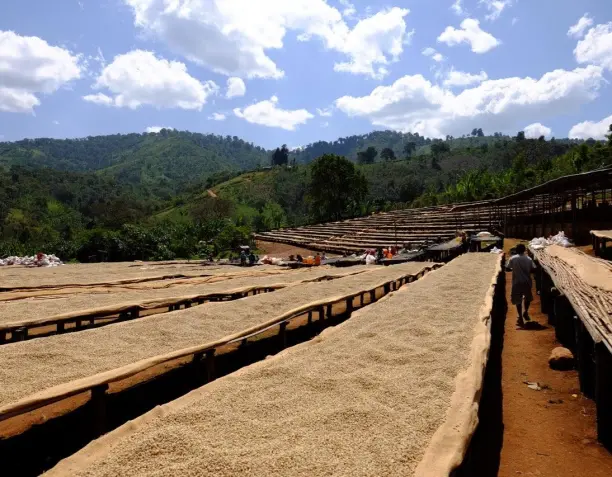
Learn why coffee drying is essential for specialty coffee quality. Discover the main drying methods and how they influence flavor, sweetness, and consistency.