




Learn about the main green coffee defects, their causes and how they can affect roasting, extraction and the flavor of the final cup.
Previous post
Why Is Natural Process Coffee Sweeter? The Science Behind Its Flavor
Date
Coffee drying is one of the most critical stages of post-harvest coffee processing. During this phase, moisture is gradually removed from the beans until they reach the ideal level for storage, transportation, and roasting.
The drying process has a direct impact on the final cup quality. Even, controlled drying helps preserve the coffee's sweetness, aromas, and complexity, while poor drying practices can introduce defects that negatively affect flavor.
In specialty coffee, careful drying is just as important as harvesting ripe cherries or roasting the beans correctly.
The goal of coffee drying is to reduce moisture slowly and evenly throughout the bean.
If coffee dries too quickly, the outer layer loses moisture faster than the center. This uneven drying creates internal stress that can damage the cellular structure and lead to inconsistent quality.
On the other hand, drying too slowly or under excessively humid conditions increases the risk of unwanted fermentation, mold growth, and other defects that can compromise the final cup.
Temperature also plays a crucial role. Excessive heat—whether from direct sunlight or poorly controlled mechanical dryers—can damage the bean's cellular structure, reducing its flavor potential and overall cup quality.
Properly dried green coffee should reach a final moisture content between 10% and 12%, the ideal range for long-term storage and roasting.
Coffee producers around the world commonly use four primary drying methods.
Concrete or clay patios remain one of the most widely used drying methods, particularly throughout Central America.
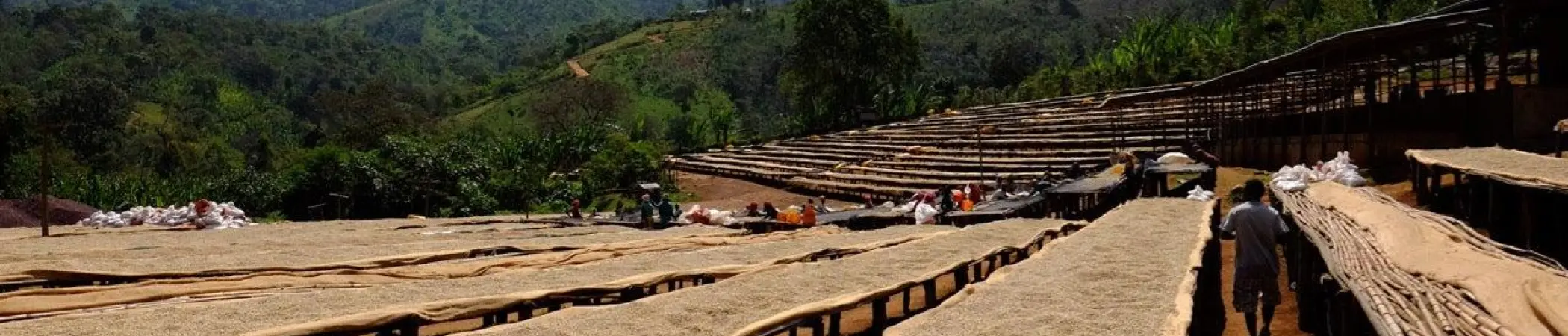
Freshly processed coffee is spread across large open patios where it dries under the sun. Throughout the day, workers regularly turn the beans using rakes to ensure even drying.
This method allows producers to dry large volumes of coffee while keeping infrastructure costs relatively low, provided they have sufficient space and favorable weather conditions.
Patios also function as natural heat reservoirs. They absorb heat during the day and gradually release it overnight, helping maintain more stable drying temperatures.
However, because air circulates only around the upper surface of the coffee, patio drying may produce less uniform results than other methods. For this reason, many producers finish the drying process using mechanical dryers.
These structures consist of wooden frames supporting mesh screens that keep the coffee elevated above the ground.
Their greatest advantage is airflow. Air circulates both above and below the coffee, allowing moisture to evaporate more evenly and producing a slower, more consistent drying process.
Raised beds are particularly well suited for Natural and Honey Process coffees, where careful drying is essential for developing sweetness, fruit complexity, and clean flavors.
They also produce excellent results for washed coffees.
Another significant benefit is their portability. Many raised beds can be assembled, disassembled, and transported easily, making them ideal for remote mountainous coffee-growing regions.
Parabolic drying beds are an evolution of traditional raised beds and were developed for coffee-growing regions with unpredictable weather, particularly Colombia.
These structures resemble small greenhouses with a curved frame covered by transparent plastic.
They protect coffee from excessive rainfall and intense sunlight while maintaining a more stable drying environment.
Proper airflow is essential. If ventilation is restricted, moisture released by the coffee condenses on the plastic roof and drips back onto the beans, slowing the drying process and increasing the risk of unwanted fermentation.
Mechanical dryers significantly reduce drying time and are especially valuable on large coffee farms or in regions with frequent rainfall.
The most important factor is temperature control. Drying temperatures should generally remain below 40°C (104°F), as excessive heat can damage the bean's internal structure and negatively affect cup quality.
Most producers combine mechanical drying with traditional sun drying. Coffee may spend several days on patios or raised beds before finishing inside a mechanical dryer.
The first stage often uses a machine known as an Oreadora, which removes approximately 3–5% of the bean's moisture.
The coffee is then transferred to a Guardiola dryer, a rotating horizontal drum that circulates warm air continuously until the desired moisture content is reached.
Many coffee-producing countries adapt their drying techniques to local climate conditions.
In Burundi, midday temperatures can become extremely high, increasing the risk of beans developing cracks during drying. To prevent this, producers often begin with approximately 48 hours of shade drying, allowing moisture to leave the beans more gradually before exposing them to sunlight.
A similar approach is widely used in Rwanda.
In Kenya, washed coffees are first spread in thin layers after soaking to remove excess surface moisture before being transferred to raised beds for the remainder of the drying process.
Colombian producers have also developed innovative multi-stage drying systems. Some begin by drying coffee indoors for the first 24 hours, allowing air circulation to equalize moisture throughout the beans before transferring them to shaded parabolic drying beds for 7 to 12 days.
Another modern technique uses multi-level parabolic drying beds. Coffee begins on the lowest level, where temperatures are cooler and sunlight is limited. As moisture decreases, the beans are gradually moved to higher levels, taking advantage of naturally increasing temperatures to complete the drying process slowly and evenly.
Coffee drying is one of the most delicate stages of coffee processing. Regardless of the method used, the objective remains the same: to reduce moisture gradually, evenly, and under carefully controlled conditions.
When drying is properly managed, coffee preserves more of its natural sweetness, aromatic complexity, and clarity in the cup. Poor drying, however, can permanently damage even the highest-quality harvest.
In specialty coffee, every stage matters—and few have as much influence on the final flavor as the drying process.
Learn about the main green coffee defects, their causes and how they can affect roasting, extraction and the flavor of the final cup.
Discover what Peaberry coffee is, how this natural coffee bean mutation develops, and whether it really tastes better than regular coffee.

How does coffee processing change your cup's flavor? Discover the differences between natural, washed, and honey methods with Blue Faro.