


We decode the most popular certifications: Fair Trade, Direct Trade, Rainforest Alliance, Organic, Cup of Excellence, UTZ, etc.
Previous post
Coffee Types & Varieties Explained | Blue Faro Coffee
Date
Before coffee becomes a brewed beverage, every bean goes through a long journey that begins on the coffee plant. The coffee species and variety, altitude, climate, cherry ripeness, processing method and grading all influence the characteristics of the green coffee and, eventually, the final cup.
Although Coffea arabica and Coffea canephora, commonly known as Robusta, are the two most important commercially cultivated coffee species, the coffee plant is far more diverse. There are numerous varieties and cultivars, each with different genetic and agronomic characteristics.
Understanding the structure and classification of green coffee helps explain why different coffees can behave very differently during roasting and brewing.
The coffee bean develops inside the coffee cherry and is protected by several layers. During processing, these structures are progressively removed while keeping the seed intact.
From the outside to the inside, the coffee cherry consists of:
Exocarp: the outer skin of the coffee cherry.
Mesocarp: the pulp beneath the skin.
Pectin layer: a mucilaginous layer surrounding the seed.
Endocarp: commonly known as parchment.
Seed coat: the thin silver skin that remains attached to the green bean.
Endosperm: the part of the seed that becomes the green coffee bean.
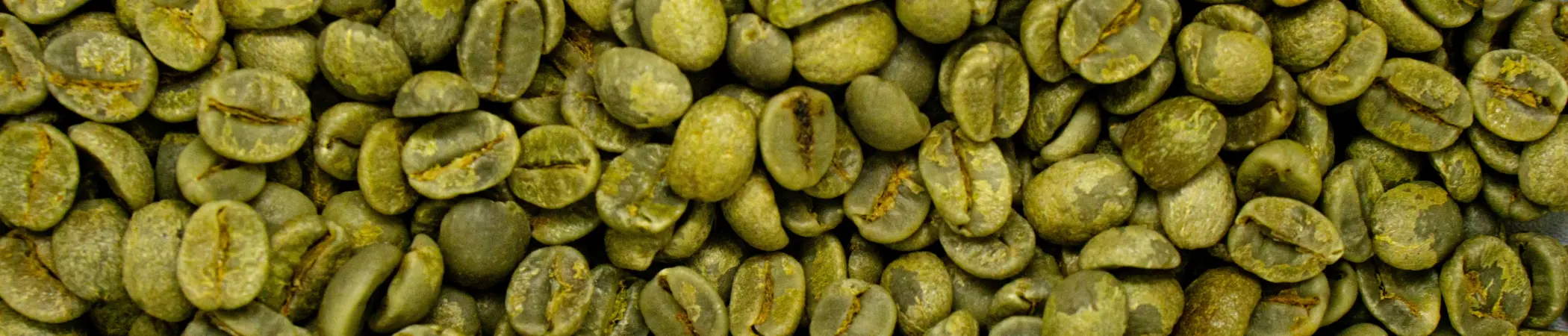
The characteristic longitudinal crease runs along the center of the bean and remains visible through processing and roasting.
How these layers are removed depends on the processing method. In washed coffee, for example, the pulp and mucilage are removed before drying. In natural processing, the whole coffee cherry is dried around the seed before the fruit is removed.
Bean size is one of the parameters used to classify green coffee. Screens, or sieves with different hole sizes, are used to separate beans according to their physical dimensions.
Screen numbering can vary slightly between grading systems, but traditional sixteenth-based classifications include:
Screen 20: approximately 8.0 mm
Screen 19: approximately 7.5 mm
Screen 18: approximately 7.1 mm
Screen 17: approximately 6.7 mm
Screen 16: approximately 6.3 mm
Screen 15: approximately 6.0 mm
Screen 14: approximately 5.6 mm
Screen 13: approximately 5.2 mm
Screen 12: approximately 4.8 mm
The terminology used for different screen sizes varies depending on the producing country and grading system.
It is important to remember that a larger coffee bean does not automatically mean higher quality. Bean size can be influenced by variety, growing conditions and cherry development, but cup quality depends on many other factors.
Bean size is therefore best understood as a physical grading parameter rather than a direct measure of sensory quality.
Most coffee cherries contain two seeds developing opposite each other. Occasionally, however, only one seed develops.
The result is a smaller, more rounded bean known as a peaberry.
Peaberries make up only a small percentage of a typical coffee harvest and are often separated during grading because of their distinctive shape.
Peaberries are sometimes considered to have superior flavor, but their shape alone does not guarantee higher quality. As with bean size, cup quality depends on the entire production and processing chain.
Green coffee grading also aims to identify and remove defects that can negatively affect cup quality.
Defects can develop at many stages, including coffee cultivation, harvesting, processing, drying, storage and transportation.
Some of the best-known defects include:
A black bean is a green coffee bean that has developed a dark coloration as a result of deterioration or undesirable fermentation processes.
Black beans can have a significant negative impact on the cup and may contribute unpleasant flavors even when present in relatively small quantities.
Insect-damaged beans contain small holes or tunnels caused primarily by insects.
This type of damage can affect the physical structure of the bean as well as its behavior during storage and roasting. Careful sorting and grading are therefore important before roasting.
Other common defects include broken beans, immature beans, fermented beans, moldy beans and beans damaged during processing.
One of the most important things to understand about green coffee grading is that there is no single universal classification system.
Different producing countries use different standards based on factors such as:
bean size;
density;
altitude;
number and type of defects;
color;
processing method;
physical quality;
cup characteristics.
For example, terms such as SHB (Strictly Hard Bean) and SHG (Strictly High Grown) are used in some producing countries to identify coffee grown at specific elevations.
These classifications can provide useful information about growing conditions, but they should not automatically be interpreted as a guarantee of sensory quality.
Altitude can influence cherry development and bean density, particularly because cooler temperatures generally slow the maturation process. However, final coffee quality depends on the interaction of many variables, including genetics, climate, soil, agricultural practices, ripeness, harvesting, processing, drying, storage and roasting.
The relationship between coffee altitude and quality is more complex than it may initially appear.
In many coffee-growing regions, higher elevations are associated with slower cherry maturation and can contribute to complex aromatic profiles and higher perceived acidity.
However, there is no universal rule stating that higher-altitude coffee is always better.
A lower-altitude coffee that is selectively harvested, carefully processed and properly dried can produce an exceptional cup. Conversely, a high-altitude coffee can still have defects if harvesting or processing is poorly managed.
Altitude is therefore an important piece of information, but it should always be considered alongside the rest of the coffee's characteristics.
For a coffee roaster, understanding the physical characteristics of green coffee is essential.
Bean size, density, moisture content, processing method and bean structure all influence how coffee responds to heat during roasting.
Two coffees with similar screen sizes may require completely different roast profiles. Likewise, washed and natural coffees can respond differently to the roasting process.
For this reason, evaluating the green coffee before roasting is an important part of developing an appropriate roast profile.
The coffee that arrives at a roastery is the result of a long chain of decisions, beginning with the variety and development of the coffee cherry and continuing through harvesting, processing, drying and storage.
Green coffee is much more than a raw ingredient. Its physical and chemical characteristics contain information about everything that happened before roasting.
Understanding those characteristics allows the roaster to make better decisions and develop roast profiles that respect the natural qualities of each coffee.
At Blue Faro, we believe that understanding coffee from its origin is an essential part of the roasting process. Every lot has its own story, and understanding that story is the first step toward producing a balanced, expressive and aromatic cup.

We decode the most popular certifications: Fair Trade, Direct Trade, Rainforest Alliance, Organic, Cup of Excellence, UTZ, etc.
Learn the meaning of key coffee tasting terms, including aroma, acidity, body, balance, complexity, flavor, and aftertaste.

What is a coffee blend and why do roasters combine different coffees? Learn how blends are created, their advantages and the role of coffee extractivity.